Let’s now try and think of the relationships of the angle and sides (i.e., our trigonometric ratios). Label the sides of the triangle in terms of its relationship with \(\theta\) (i.e., angle \(B\)).
Answer.
Students should label the sides so that the following sides should be labeled as:
\(a\) is the adjacent side of \(\theta\)
\(b\) is the opposite side of \(\theta\)
\(c\) is the hypotenuse
(d)
Replace \(a\text{,}\)\(b\text{,}\) and \(c\) in the equation we got in part (c) with how you labeled the sides in part (d).
Answer.
Replacing the \(a\text{,}\)\(b\text{,}\) and \(c\) in the equation
Note that each of these identities can be written in different forms, which are all equivalent to one another. For example, \(\sin^2\theta + \cos^2\theta = 1\) can be rewritten as \(1 - \sin^2\theta = \cos^2\theta\) or \(1 - \cos^2\theta = \sin^2\theta\text{.}\) You will want to become familiar with all these forms.
Remark8.1.7.
Activity8.1.8.
Refer back to the unit circle to determine the exact value of \(\sin\left( \pi + \frac{\pi}{2}\right)\text{.}\)
(a)
What is the value of \(\sin \pi\text{?}\)
\(\displaystyle -1\)
\(\displaystyle 0\)
\(\displaystyle 1\)
Answer.
B
(b)
What is the value of \(\sin \frac{\pi}{2}\text{?}\)
\(\displaystyle -1\)
\(\displaystyle 0\)
\(\displaystyle 1\)
Answer.
C
(c)
Based on your answers from parts (a) and (b), what do you think the value of \(\sin\left( \pi + \frac{\pi}{2}\right)\) is?
Answer.
Students will probably make the conjecture that the value of \(\sin\left( \pi + \frac{\pi}{2}\right)\) is just \(\sin \pi + \sin \left( \frac{\pi}{2} \right)\text{,}\) which equals \(1\text{.}\)
(d)
Let’s test your conjecture from part (c). What is the value of \(\pi + \frac{\pi}{2}\text{?}\)
\(\displaystyle \frac{2\pi}{2}\)
\(\displaystyle \pi\)
\(\displaystyle \frac{3\pi}{2}\)
\(\displaystyle \frac{2\pi}{3}\)
Answer.
C
(e)
What is the value of \(\sin \left( \frac{3\pi}{2} \right)\text{?}\)
\(\displaystyle -1\)
\(\displaystyle 0\)
\(\displaystyle 1\)
Answer.
A
(f)
Is it safe to assume that \(\sin\left( \pi + \frac{\pi}{2}\right) = \sin \pi + \sin \left( \frac{\pi}{2} \right)\text{?}\)
So from this example, we can see that it is NOT safe to assume that \(\sin\left( \pi + \frac{\pi}{2}\right) = \sin \pi + \sin \left( \frac{\pi}{2} \right)\text{.}\)
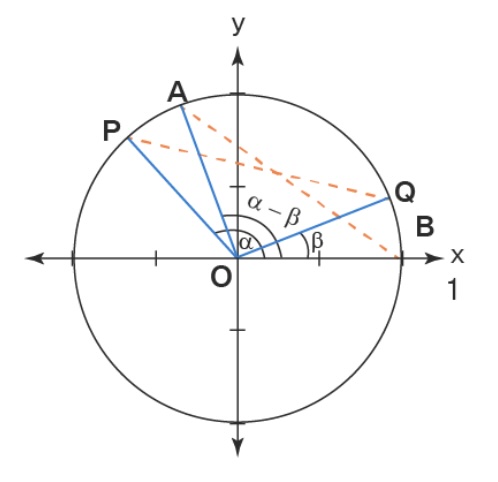
Recall that the coordinates of points on the unit circle are given by \((\cos\theta, \sin\theta)\text{.}\) In the unit circle shown below, point \(P\) makes an angle \(\alpha\) with the positive \(x\)-axis and has coordinates \((\cos\alpha, \sin\alpha)\) and point \(Q\) makes an angle \(\beta\) with the positive \(x\)-axis and has coordinates \((\cos\beta, \sin\beta)\text{.}\) Point \(B\) has coordinates \((1,0)\text{.}\)
Figure8.1.11.Image of the unit circle used to derive the difference formula.
(a)
Note that angle \(AOB\) is equal to \(\left(\alpha-\beta\right)\text{.}\) What are the coordinates of point \(A\text{?}\)
Answer.
Point \(A\) has coordinates \((\cos (\alpha - \beta), \sin (\alpha - \beta))\text{.}\)
(b)
Triangles \(POQ\) and \(AOB\) are rotations of one another. What can we say about the lengths of \(PQ\) and \(AB\text{?}\)
Answer.
Because triangles \(POQ\) and \(AOB\) are rotations of one another, we know that the lengths of \(PQ\) and \(AB\) are the same. That is, the distance from \(P\) to \(Q\) is equal to the distance from \(A\) to \(B\text{.}\)
(c)
Let’s use the distance formula, \(d=\sqrt{(x_2-x_1)^2+(y_2-y_1)^2}\text{,}\) to find the length of \(PQ\text{.}\) What do you get when you plug in the coordinates of point \(P\) and point \(Q\text{?}\)
Remember that point \(P\) has coordinates \((\cos\alpha, \sin\alpha)\) and point \(Q\) has coordinates \((\cos\beta, \sin\beta)\text{.}\)
Answer.
A or C, depending on which point students started with first
(d)
Begin simplifying your answer from part (c) by applying the algebraic identity \(\left(a-b\right)^2=a^2-2ab+b^2\text{.}\) What do you get when squaring the two binomials under the radical?
A or D, depending on which point students started with first
(e)
Simplify your answer from part (d) even further by applying the Pythagorean Identity, \(\cos^2\theta+\sin^2\theta=1\text{.}\) What does your answer from part (d) simplify to?
The Sum and Difference Formulas in trigonometry are used to find the value of the trigonometric functions at specific angles where it is easier to express the angle as the sum or difference of unique angles such as \(0^\circ \text{,}\)\(30^\circ\text{,}\)\(45^\circ\text{,}\)\(60^\circ\text{,}\)\(90^\circ\text{,}\) and \(180^\circ\text{.}\)
The six main trigonometric sum and difference formulas are:
Use the unit circle and Theorem 8.1.13 to find the exact value of \(\cos75\)°.
(a)
Split \(75\)° into the sum of two angles which can be found on the unit circle (use unique angles such as \(0\)°, \(30\)°, \(45\)°, \(60\)°, \(90\)°, and \(180\)°, etc.).
Answer.
\(30\)° and \(45\)°
(b)
Rewrite \(\cos75\)° as \(\cos\left(\alpha+\beta\right)\) where \(\alpha\) and \(\beta\) are the two angles you found in part (a).
Answer.
\(\cos75= \cos\left(30 + 40\right)\)
(c)
Apply Theorem 8.1.13 to rewrite \(\cos75\)° with four trigonometric functions.
Answer.
\(\cos75=\cos30\cos45-\sin30\sin45\)
(d)
Use the unit circle to find the value of each trigonometric function in the formula you wrote in part (c).
Recall from Theorem 8.1.13 the sum formulas for sine, cosine, and tangent.
(a)
Suppose \(\alpha=\beta\text{.}\) Rewrite the left-hand and right-hand sides of the sum formula for sine \(\left(\sin\left(\alpha+\beta\right)=\sin\alpha\cos\beta+\cos\alpha\sin\beta\right)\) in terms of \(\alpha\text{.}\)
Suppose \(\alpha=\beta\text{.}\) Rewrite the left-hand and right-hand sides of the sum formula for cosine \(\left(\cos\left(\alpha+\beta\right) =\cos\alpha\cos\beta-\sin\alpha\sin\beta\right)\) in terms of \(\alpha\text{.}\)
Suppose \(\alpha=\beta\text{.}\) Rewrite the left-hand and right-hand sides of the sum formula for tangent \(\left(\tan\left(\alpha+\beta\right)=\frac{\tan\alpha+\tan\beta}{1-\tan\alpha\tan\beta}\right)\) in terms of \(\alpha\text{.}\)
Double angle formulas are used to express the trigonometric ratios of double angles \((2\theta)\) in terms of trigonometric ratios of single angle \((\theta)\text{.}\)
The Double Angle Formulas of sine, cosine, and tangent are:
Suppose \(\sin\alpha=\frac{2}{3}\) and \(\alpha\) lies in Quadrant I.
(a)
Use the Pythagorean Identities and Theorem 8.1.19 to find \(\sin2\alpha\text{.}\)
Answer.
Use \(\sin^2\theta+\cos^2\theta=1\) to find the value of \(\cos\alpha\text{,}\) which is equal to \(\frac{\sqrt5}{3}\text{.}\) Then, use the double angle formula to find that \(\sin2\alpha=\frac{4\sqrt5}{9}\text{.}\)
(b)
Use the Pythagorean Identities and Theorem 8.1.19 to find \(\cos2\alpha\text{.}\)
Answer.
From part (a), we know that \(\cos\alpha = \frac{\sqrt5}{3}\) and \(\sin\alpha = \frac{2}{3}\text{.}\) So, by using the double angle formula \(\cos^2\alpha - \sin^2\alpha\text{,}\) we know that \(\cos2\alpha = \frac{5}{9} - \frac{4}{9}\text{,}\) which equals \(\frac{1}{9}\text{.}\)
(c)
Use the Pythagorean Identities and Theorem 8.1.19 to find \(\tan2\alpha\text{.}\)
Answer.
From part (a), we know that \(\cos\alpha = \frac{\sqrt5}{3}\) and \(\sin\alpha = \frac{2}{3}\text{.}\) So, \(\tan\alpha = \frac{\frac{2}{3}}{\frac{\sqrt5}{3}}\text{,}\) which is equal to \(\frac{2}{\sqrt5}\text{.}\) By using the double angle formula \(\frac{2\tan\alpha}{1-\tan^2\alpha}\text{,}\) we know that \(\tan2\alpha = \frac{\frac{4}{\sqrt5}}{1-\frac{4}{5}}\text{,}\) which equals \(-4\sqrt5\text{.}\)
Activity8.1.21.
The double-angle formulas can be used to derive the reduction formulas, which are formulas we can use to reduce the power of a given expression involving even powers of sine or cosine.
(a)
Let’s start with the double angle formula for cosine to find our first power-reduction formula: \(\cos2\theta=1-2\sin^2\theta\text{.}\) Use your algebra skills to solve for \(\sin^2\theta\text{.}\)
Answer.
\(\sin^2\theta=\frac{1-\cos2\theta}{2}\)
(b)
Given the second double angle formula,\(\cos2\theta=2\cos^2\theta-1\)\(\text{,}\) solve for \(\cos^2\theta\text{.}\)
Answer.
\(\cos^2\theta=\frac{1+\cos2\theta}{2}\)
(c)
To generate the power reduction formula for tangent, let’s begin with its definition: \(\tan^2\theta=\frac{\sin^2\theta}{\cos^2\theta}\text{.}\) Use the formulas you created in parts (a) and (b) to rewrite \(\tan^2\theta\text{.}\)
Notice that you still have a cosine function being squared in your equation in part (c). Substitute the \(\cos^2\beta\) using the power reduction formula in Theorem 8.1.22 and then simplify
Answer.
\(\frac{2-4\cos\beta+1+\cos4\beta}{8}\) or \(\frac{3-4\cos2\beta+\cos4\beta}{8}\)
Activity8.1.24.
The next set of identities is the set of half-angle formulas, which can be derived from the reduction formulas. Let’s derive the half-angle formula for \(\sin\frac{\theta}{2}\text{.}\)
(a)
Recall the power reduction formula: \(\sin^2\theta=\frac{1-\cos2\theta}{2}\text{.}\) Replace \(\theta\) with \(\frac{\theta}{2}\text{.}\)
\(\sin\frac{\theta}{2}=\sqrt{\frac{1-\cos\theta}{2}}\) or \(\sin\frac{\theta}{2}=-\sqrt{\frac{1-\cos\theta}{2}}\) depending on which quadrant \(\theta\) is in.
\(\cos\frac{\theta}{2}=\sqrt{\frac{1+\cos\theta}{2}}\) or \(\cos\frac{\theta}{2}=-\sqrt{\frac{1+\cos\theta}{2}}\) depending on which quadrant \(\theta\) is in.
\(\tan\frac{\theta}{2}=\sqrt{\frac{1-\cos\theta}{1+\cos\theta}}=\frac{\sin\theta}{1+\cos\theta}=\frac{1-\cos\theta}{\sin\theta}\) or \(\tan\frac{\theta}{2}=-\sqrt{\frac{1-\cos\theta}{1+\cos\theta}}=\frac{\sin\theta}{1+\cos\theta}=\frac{1-\cos\theta}{\sin\theta}\) depending on which quadrant \(\theta\) is in.
Activity8.1.27.
Find \(\sin15°\) using a half-angle formula in Theorem 8.1.26.
(a)
Which quadrant is the angle \(15\)° in?
Answer.
Quadrant I
(b)
What angle is \(15\)° half of?
Answer.
\(30\)°
(c)
Which half angle formula should we use to determine \(\sin15°\text{?}\)
Answer.
Because the angle \(15\)° lies in Quadrant I, we should use the formula: \(\sin\frac{\theta}{2}=\sqrt{\frac{1-\cos\theta}{2}}\text{.}\)
(d)
Substitute \(\theta\) with \(30\)° in the half-angle formula for sine.